
Picking the wrong supplier can cost a business far more than just money. Delayed shipments, inconsistent tolerances, and failed quality audits can stall an entire production line – and fixing those problems after the fact is always harder than preventing them upfront.
For B2B buyers sourcing from a brass pipe fittings manufacturer in India, the stakes are high. India – particularly Gujarat – is home to hundreds of manufacturers, ranging from large-scale precision units to small job shops. Knowing how to tell them apart before you sign a purchase order is the difference between a supply chain that runs smoothly and one that gives you headaches every quarter.
This guide walks you through exactly what to look for when evaluating Indian manufacturers – from certifications and product range to export experience and quality controls.
Why India Has Become a Go-To Source for Brass Pipe Fittings
Jamnagar, Gujarat is widely regarded as the brass manufacturing capital of the world. The city accounts for a massive share of India’s brass fittings output, with thousands of units producing everything from compression fittings and flare fittings to forged valves and quick tube connectors.
The reasons global buyers keep coming back to India are straightforward: competitive raw material costs, a well-developed ecosystem of precision machining, and a large workforce that has spent generations refining these skills. Add to that the proximity of major export ports like Mundra and Kandla, and it becomes clear why India punches well above its weight in this category.
But none of that matters if you end up working with a manufacturer who can’t hold tolerances, lacks documentation, or goes silent the moment a quality complaint lands in their inbox.
Check Certifications Before Anything Else
The first filter any serious buyer should apply is certifications. ISO 9001:2015 is the baseline – it tells you that a manufacturer has a documented quality management system in place, not just on paper but verified by an external body.
Beyond ISO, look for RoHS and REACH compliance if you’re exporting to Europe or supplying to industries with strict material restrictions. CE marking is another signal that a manufacturer understands international product standards and has invested in meeting them.
Why Compliance Documentation Matters for Global Trade
When a brass pipe fittings exporter in India ships to the EU, the US, or Southeast Asia, customs and end-clients often require material compliance certificates. If a manufacturer can’t produce these documents quickly and accurately, it usually means they haven’t been audited to that standard – or they’re generating paperwork after the fact, which is a red flag.
Ask prospective suppliers directly: “Can you provide RoHS and REACH compliance certificates for your products?” The speed and confidence of their response tells you a lot.
Evaluate the Product Range and Manufacturing Capability
A manufacturer with a wide product range backed by in-house machining is generally more reliable than one that outsources certain components. When everything from raw bar stock to finished fitting is handled under one roof, dimensional consistency is far easier to maintain.
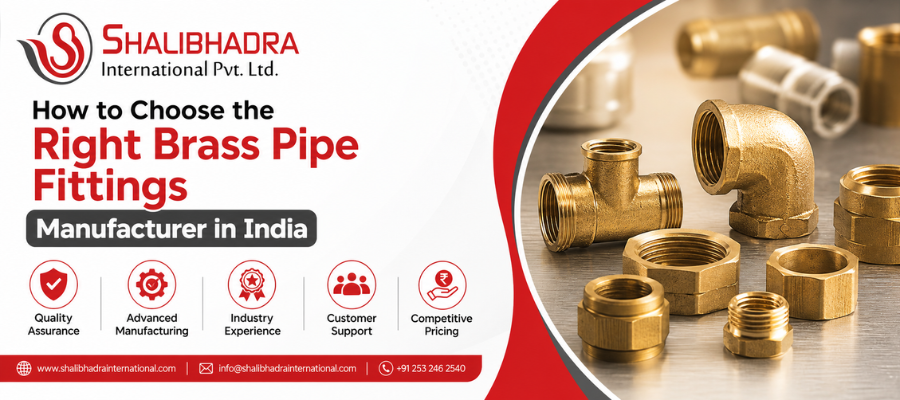
When assessing a potential brass pipe fittings manufacturer in India, look at what categories they actually produce. Compression fittings, flare fittings, forged valves, hose barb fittings, and quick tube connectors all have different production requirements. A factory that can handle all of these confidently typically has both the machinery and the process knowledge to support varying specifications.
Also ask about CNC capability. Semi-automatic machines work well for standard parts, but CNC machining is essential when you need tight tolerances on custom components. A manufacturer that has both gives you more flexibility as your requirements evolve.
Custom Orders and OEM Support
For buyers who need custom-designed brass fittings – specific thread profiles, unusual sizes, proprietary designs – the manufacturer’s ability to handle OEM orders matters. Ask whether they work from engineering drawings, what their minimum order quantities are for custom runs, and how they manage first-article inspection before bulk production begins.
Assess Export Experience and Documentation Handling
Working with a brass pipe fittings exporter in India who has a proven international track record is very different from working with a manufacturer that primarily supplies domestic buyers and has added “exporter” to their website as an afterthought.
Look for manufacturers who hold an active DGFT Importer-Exporter Code (IEC), a DUNS number, and who can walk you through their export documentation process without hesitation. This includes commercial invoices, packing lists, country-of-origin certificates, and any product-specific compliance paperwork your import country requires.
Experience with specific regions matters too. A manufacturer who regularly supplies to the EU will already understand the documentation requirements there. One who primarily ships to the Middle East may need guidance if you’re ordering for a European end-customer. It’s worth asking upfront where their current export markets are.
Visit the Factory – or Request a Virtual Audit
No amount of website photography replaces actually seeing a facility. If you can visit Jamnagar, do it. Walk through the production floor, look at how raw material is stored, observe whether the QC lab is active or decorative, and meet the team that would actually handle your account.
If an in-person visit isn’t possible – which is often the reality for international buyers – a virtual factory tour is the next best option. Ask the manufacturer to walk you through their facility on a video call. Watch for how organized the floor is, how machines are maintained, and whether they seem comfortable showing you things unscripted.
A manufacturer who has nothing to hide will welcome this. One who deflects or offers only pre-recorded footage is worth being cautious about.
Quality Control: Look Beyond the Certificate on the Wall
ISO certification is a good starting point, but the real question is what quality control actually looks like at each stage of production. Ask specifically about their incoming raw material inspection process, in-process checks during machining, and final dimensional testing before dispatch.
Good manufacturers in this space will test every batch against drawings, verify surface finishes, and maintain traceability so that if a defect is found later, they can trace it back to the specific production run. If a manufacturer can’t explain their QC process in detail, or if it sounds like inspection only happens “at the end,” that’s a sign the system isn’t mature.
Surface finish is another thing buyer overlook. Nickel plating, chrome plating, and natural brass finishes all behave differently in different environments. Confirm that the manufacturer tests the finish quality – not just the dimensions.
Evaluate Communication and Responsiveness
The quality of communication before you place an order is a reliable predictor of how well a supplier will handle problems after. A manufacturer who takes days to respond to a basic inquiry, sends vague answers, or can’t explain their product specs clearly will be much harder to work with once you’re in the middle of a production cycle.
Pay attention to whether they ask smart questions about your requirements. A manufacturer who simply quotes without understanding your application might be quoting the wrong product. One who asks about thread standards, pressure ratings, and end-use environment is demonstrating that they understand what they’re making.
Price matters – no one disputes that. But the total cost of a sourcing decision includes far more than the per-unit rate on the purchase order. Rework, shipping delays, compliance failures, and damaged customer relationships all carry real costs that a slightly cheaper fitting can’t offset.
When you’ve done the groundwork – verified certifications, assessed manufacturing capability, confirmed export experience, and tested the quality of communication – you’re in a much stronger position to choose a brass pipe fittings manufacturer in India who will actually perform over the long term.
Take your time with the evaluation. Ask hard questions. Request samples before committing to volume. The right manufacturer will not only be able to meet your specifications today but will also have the infrastructure to scale with your requirements as your business grows. If you’re evaluating suppliers in Gujarat, Shalibhadra International is a Jamnagar-based, ISO 9001:2015 certified brass pipe fittings manufacturer with over 22 years of production experience and active export relationships across Europe, the Middle East, and Southeast Asia. You can explore the product range or reach out directly to discuss your specific requirements.