
Whether you are an engineer sourcing parts for a new product line or a procurement manager looking for a reliable metal precision component supplier – this guide is for you. We break down exactly what precision components are, what they are made from, how they are made, and which industries depend on them every single day.
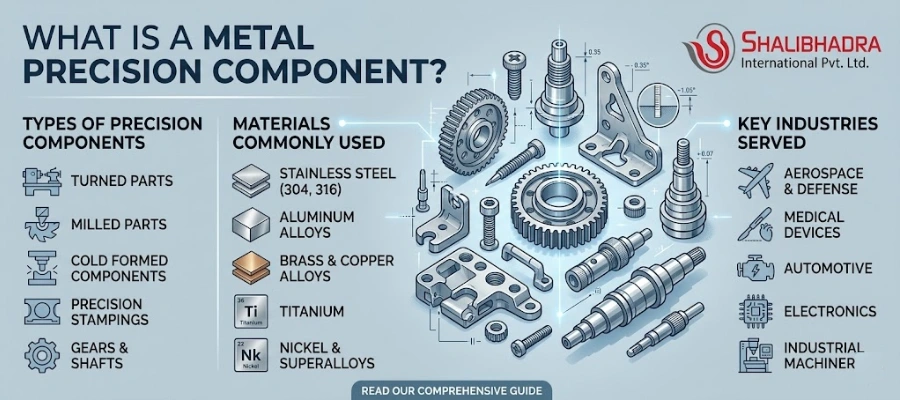
What Is a Metal Precision Component?
Let us start with the basics – because understanding this clearly can save you time, money, and a lot of back-and-forth with your supplier.
A metal precision component is a machined or formed metal part manufactured to very tight dimensional tolerances. In plain terms, it is a metal part that must be made exactly right – down to fractions of a millimetre – so that it fits, functions, and performs reliably inside a larger assembly.
Think of the tiny brass insert inside a plastic connector. Or the terminal block inside an electrical panel. Or the compression fitting sealing a water pipe. None of these parts can afford to be “close enough.” They must be precise.
That is what separates a precision component from a standard metal part. The difference lies in:
- Tolerances – how close the finished dimension must be to the specified measurement
- Surface finish – how smooth or textured the surface must be
- Consistency – every single piece in a batch must match the one before it
When you work with a trusted metal precision component manufacturer, you are not just buying a part. You are buying confidence that every component in every shipment will perform exactly as designed.
How Are Metal Precision Components Made?
Understanding the manufacturing process helps you ask the right questions when evaluating a metal precision component supplier.
Most precision components are made using one or more of these core processes:
CNC Turning
A bar of raw metal spins at high speed while a cutting tool removes material with extreme accuracy. This is ideal for cylindrical parts like inserts, spacers, connectors, and fittings. Modern CNC lathes can hold tolerances as tight as ±0.005 mm.
CNC Milling (VMC Machining)
The metal workpiece is held still while rotating cutting tools remove material in precise paths. VMC machining is used for components with flat surfaces, slots, holes, and complex geometries.
Forging
Metal is shaped under high pressure using dies. Forged parts are exceptionally strong because the metal’s grain structure is aligned during the process. Brass valves and fittings are commonly forged for this reason.
Grinding and Finishing
After primary machining, components often go through grinding, lapping, or polishing to achieve the exact surface finish specified. This is where “precision” truly earns its name.
Every reputable metal precision component manufacturer will also perform multi-stage quality checks – including dimensional inspection using vernier calipers, micrometers, and CMM (Coordinate Measuring Machines) – before any component leaves the facility.
Types of Metal Precision Components
Precision components come in many shapes and serve many functions. Here are the most common types you will encounter:
1. Inserts and Threaded Inserts
Used in plastic moulding, electronics, and automotive assemblies to provide strong, durable threaded connections inside softer materials. Brass knurled inserts, heat-set inserts, and hex inserts are widely used examples.
2. Fittings and Connectors
Compression fittings, flare fittings, BSP fittings, and push-to-connect (PU) fittings control and direct the flow of fluids or gases in plumbing, HVAC, and industrial systems. Precision here is non-negotiable – even a tiny dimensional error can cause leaks.
3. Fasteners
Precision bolts, screws, nuts, and studs manufactured to exact thread pitch and head dimensions. Brass and MS fasteners are used extensively in electrical enclosures and mechanical assemblies.
4. Terminal Blocks, Bars, and Neutral Links
These are the backbone of electrical distribution panels. They provide safe, reliable connection points for multiple wires and cables. Dimensional accuracy ensures correct clamping force and electrical conductivity.
5. Standoffs, Spacers, and Pillars
Used in PCB (printed circuit board) assemblies to maintain precise spacing between boards or between a board and an enclosure. Even a 0.1 mm variation can cause assembly failure.
6. Valves and Flow Control Components
Forged brass valves, ball valves, and needle valves are critical in plumbing, gas distribution, and industrial fluid systems. They must withstand pressure and temperature cycles over thousands of operating hours.
7. Earthing and Grounding Components
Brass earthing blocks and neutral bars provide low-resistance grounding paths in electrical systems. Incorrect dimensions or poor conductivity can create safety hazards.
Materials Used in Metal Precision Components
The material you choose affects strength, corrosion resistance, conductivity, machinability, and cost. Here is a clear breakdown:
Brass (Copper-Zinc Alloy)
Brass is the most widely used material in precision component manufacturing – and for good reason. It offers:
- Excellent machinability (cuts cleanly with minimal tool wear)
- Natural corrosion resistance
- High electrical and thermal conductivity
- Compliance with RoHS and REACH environmental standards (in lead-free grades)
Brass is the material of choice for fittings, inserts, connectors, terminals, and valves. Jamnagar, Gujarat – home to over 5,000 brass manufacturing units – is the undisputed global centre for precision brass components.
Aluminium
Lightweight yet strong, aluminium is used where weight is a concern – aerospace, automotive, and electronics cooling components. It machines well and can be anodised for surface protection.
Mild Steel (MS) and Stainless Steel
Steel components offer superior tensile strength. MS inserts and fasteners are common in structural and mechanical applications. Stainless steel is chosen where both strength and corrosion resistance are needed – food processing, marine, and medical equipment.
Copper
Used in high-conductivity electrical applications such as busbars, earthing strips, and terminal connections. Pure copper offers the lowest electrical resistance of any common engineering metal.
Industries That Depend on Metal Precision Components
The demand for reliable precision components is driven by industries where failure is simply not an option.
Electrical and Electronics
Terminal blocks, neutral bars, earthing blocks, and electrical connectors are the foundation of safe power distribution. Every switchgear panel, distribution board, and control cabinet contains dozens of precision brass components.
Plumbing and HVAC
Compression fittings, flare fittings, valves, and hose fittings must seal reliably under pressure and temperature variation. A single faulty fitting can result in water damage worth lakhs of rupees.
Automotive and EV Manufacturing
From fuel system fittings to EV battery connectors and plastic housing inserts, the automotive sector requires components in high volumes with zero tolerance for dimensional variation.
Telecommunications
Precision connectors, standoffs, and PCB spacers keep sensitive electronic assemblies correctly aligned and electrically isolated. As 5G infrastructure expands, demand for these components is growing rapidly.
Solar Energy
Mounting hardware, cable glands, and fluid fittings in solar thermal systems require corrosion-resistant precision components that perform reliably outdoors for 20–25 years.
Aerospace and Defence
The highest standards in the industry. Components here must meet certification requirements (AS9100, MIL-SPEC) and be fully traceable from raw material to finished part.
What to Look for in a Metal Precision Component Manufacturer
Choosing the right metal precision component manufacturer is one of the most important decisions in your supply chain. Here is what genuinely matters:
Certifications – ISO 9001:2015 is the baseline. For export to Europe, look for CE, RoHS, and REACH compliance.
In-house capabilities – A manufacturer who controls the entire process (raw material, machining, inspection, packaging) gives you far better consistency than one who sub-contracts stages.
Quality inspection – Ask about their CMM and dimensional inspection processes. Every serious precision manufacturer runs multi-stage QC.
Experience in your industry – A manufacturer who already supplies your sector understands your standards, tolerances, and documentation requirements.
Export track record – If you are importing, verify the manufacturer’s DGFT IE Code, DUNS number, and experience with your country’s import compliance requirements.
Why Shalibhadra International Is a Trusted Metal Precision Component Supplier
At Shalibhadra International Pvt. Ltd., we have been manufacturing precision brass and metal components from Jamnagar, Gujarat since 2002 – over 22 years of uninterrupted production.
We are ISO 9001:2015 certified, CE and RoHS compliant, and equipped with advanced CNC and semi-automatic machining at our 2,000+ sq. ft. GIDC Phase III facility. Our team of 30–35 trained professionals handles everything from raw material inspection to final dimensional testing and export documentation.
As a trusted metal precision component manufacturer and supplier, we export to clients across Europe, the USA, the Middle East, and Southeast Asia – and supply pan-India to Delhi, Mumbai, Chennai, Ahmedabad, Bangalore, and beyond.
Frequently Asked Questions
What tolerances can a precision metal component manufacturer hold? Most CNC-machined components can hold tolerances of ±0.01 mm to ±0.05 mm. Ultra-precision applications can achieve ±0.005 mm or tighter with the right equipment and process control.
What is the minimum order quantity for precision components? This varies by manufacturer and component complexity. Many suppliers, including Shalibhadra International, accommodate both small batch and high-volume orders.
How do I verify a metal precision component supplier’s quality? Request ISO certificates, ask for sample components with inspection reports, and check for RoHS/CE compliance documentation if you are importing to Europe. What is the lead time for custom precision components? Standard components typically ship within 7–15 working days. Custom or complex components may require 3–6 weeks depending on tooling and volume.