
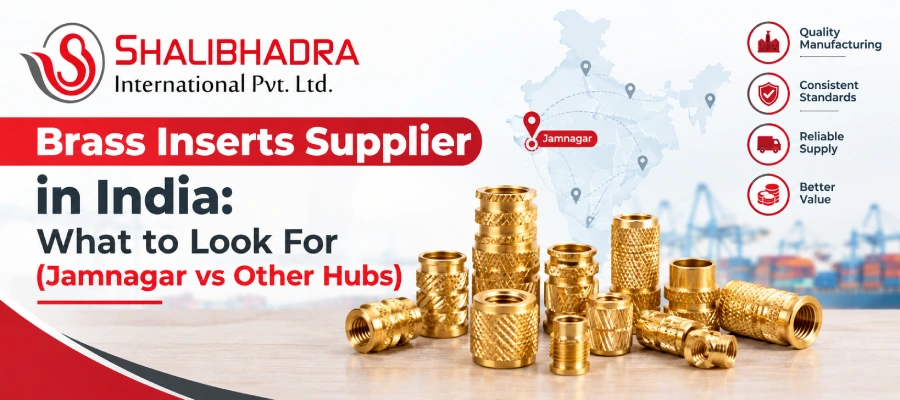
A brass insert is a small part that carries a big share of the blame when a product fails in the field. A stripped thread in a moulded housing, a loose knurl in a switch body, a cracked casting in a sanitary fitting: each one traces back to a decision made months earlier, when someone picked a brass inserts supplier based on a quote sheet.
India has several brass hubs, and Jamnagar in Gujarat is the one most buyers hear about first. This guide explains how Jamnagar compares with Moradabad, Aligarh and Rajkot, and which checks separate a dependable factory from a risky one.
The best brass inserts supplier for most Indian buyers is a Jamnagar manufacturer with in-house CNC and screw machining, spectrometer-verified material certificates, and thread gauging on every batch. Moradabad and Aligarh suit decorative or hardware work better. Whatever the hub, the factory’s testing discipline matters more than its postal address.
Why Jamnagar Became India’s Brass Parts Capital
Jamnagar earned its reputation through decades of small-batch machining rather than one large plant. The city, on the Saurashtra coast of Gujarat, is widely called India’s brass parts capital, and local industry bodies describe a cluster of several thousand small units making turned components, forgings, and fittings. Most of them are family-run workshops that grew into proper factories, and a good number now export to Europe, the Middle East and North America.
The cluster’s real advantage is the supporting ecosystem around the machines. Raw brass rod, scrap recycling, die makers, plating shops and tool grinders all sit within a few kilometres of each other, so a new insert design can move from drawing to sample in days rather than weeks. That density also keeps unit costs low, because no single factory has to carry every process itself.
Port access adds another edge for overseas buyers working with a brass inserts exporter. Kandla and Mundra, Gujarat’s two major container ports, sit roughly 300 km from Jamnagar by road, and the smaller Sikka port is closer still. Shorter inland haulage trims days off the journey from factory gate to vessel, which helps when production overseas runs to a fixed schedule.
Jamnagar vs Moradabad, Aligarh and Rajkot
Each Indian brass hub grew around a different kind of demand, so the right choice depends on what the insert will do. Moradabad built its name on decorative brassware and handicrafts, Aligarh on locks and builders’ hardware, and Rajkot on engineering components for pumps, diesel engines and machine tools. The table below sums up where each one fits a precision insert order.
| Hub | Known for | Strength for inserts | Watch out for |
| Jamnagar | Turned brass parts, fittings | Precision machining, wide size range, export experience | Quality varies widely between units |
| Moradabad | Handicrafts, decorative brass | Casting, finishing, plating | Fewer precision screw-machine shops |
| Aligarh | Locks, builders’ hardware | Cost-efficient hardware-grade parts | Tolerances set for hardware, not moulding |
| Rajkot | Engineering goods, pumps | Tooling base, CNC capacity | Brass is a side line for many shops |
Jamnagar wins for threaded and knurled inserts because most of its shops run automatic lathes and CNC turning centres built for small turned parts. A knurled insert for plastic moulding needs a consistent knurl, a tight outer diameter and a clean thread, and those are everyday work for a Jamnagar brass products manufacturing factory. Rajkot can match the machining, though brass is rarely the main business there.
Moradabad and Aligarh remain sensible for other jobs. A decorative brass knob with an integrated threaded boss, or a lock component produced in large volume at hardware-grade tolerances, fits those clusters well. An insert for a medical device or an automotive sensor does not, and buyers should be honest with themselves about which category their part falls into.
What Should You Check Before Choosing a Brass Inserts Supplier?
Material Certificates and Alloy Grade
Alloy grade decides how an insert machines, how it holds a thread and whether it passes compliance checks. Free-cutting brass such as CW614N (CuZn39Pb3) or C36000 is the usual choice for turned inserts, with roughly 2.5 to 3.5 percent lead helping chips break cleanly.
Buyers shipping to the EU should confirm the grade against RoHS, which permits up to 4 percent lead in copper alloys under a specific exemption. If the finished product touches drinking water, ask for lead-free options such as silicon brass or bismuth brass instead.
A mill test certificate alone is not proof. A serious supplier runs optical emission spectrometer checks on incoming rod and keeps batch records that link each production lot to a heat number.
Thread and Dimensional Control
Dimensional control shows up first in the thread, so ask how it is checked. Reliable factories use go/no-go gauges on every batch, typically to ISO 6H for internal threads and 6g for external ones, and record pull-out and torque values for inserts that go into plastic. A supplier who cannot share those numbers is guessing.
Concentricity and knurl quality matter just as much for moulded-in parts. If the knurl is shallow or uneven, plastic flows around it poorly and the insert spins under torque. Asking for a few sample pieces and testing them in your own tool is the fastest way to see this.
Factory Capability and Paperwork
A brass inserts manufacturer should show you the machines, not just the catalogue. Look for in-house CNC turning, a tool room for knurling tools and thread gauges, and a quality lab with a profile projector or CMM. ISO 9001 certification is a reasonable baseline, and IATF 16949 signals experience with automotive customers.
How Do Pricing and Minimum Order Quantities Work?
Brass is priced by weight, so the metal market sets the baseline for every quote. Copper and zinc prices on the LME move daily, and a supplier’s rod cost follows them with a short lag, which is why serious quotes carry a short validity window. Machining cost then depends on cycle time per piece, tooling and scrap.
Minimum order quantities are negotiable more often than buyers assume. Many Jamnagar shops accept trial lots of a few thousand pieces for standard sizes, while custom knurl patterns or special threads usually need a one-time tooling charge. Ask in writing who owns the tooling and whether the charge is credited against later orders.
Red Flags Worth Catching Before You Sign
Some warning signs show up in the first week of conversation. A supplier who quotes without asking for a drawing, alloy specification or annual volume is pricing a guess, and the guess usually gets corrected after the order is placed.
Unusually low prices deserve extra suspicion. A quote far below the rest of the field often points to a cheaper alloy, recycled rod with uncontrolled lead content, or skipped inspection steps.
Missing paperwork is the other common warning. If a supplier hesitates to share a sample inspection report, a material certificate or photographs of the production floor, treat that hesitation as an answer. Visiting the factory, or hiring a local inspection agency for a day, costs far less than a rejected container.
Frequently Asked Questions
A brass insert is a threaded metal fitting, usually knurled on the outside, that gets moulded or pressed into plastic, wood or composite parts to create a strong, reusable thread. Electronics, appliances, automotive interiors and furniture all rely on them.
Start with a sample lot and test it for thread fit, pull-out strength and alloy composition. Then request the ISO certificate, a recent material test report and a video or in-person tour of the production floor.
Yes, many Jamnagar factories export directly. Established exporters usually handle packing, export documentation and RoHS declarations in-house, so ask for references from overseas customers in your own industry.
Standard sizes typically ship within two to three weeks of a confirmed order. Custom designs need tooling and sample approval first, which often adds another three to four weeks, and plating extends the schedule further.
A manufacturer owns the machines and controls production, while an exporter may be a trading company that sources from several factories. Many Jamnagar firms act as both, which keeps quality and shipping under one roof.
The smartest first move is a small paid trial, not a large order. Pick two or three Jamnagar candidates and one from another hub for contrast, then send each the same drawing, alloy specification and test requirements. Compare the samples on thread fit, knurl depth and pull-out strength in your own moulding or assembly process, and compare how each factory answers difficult questions along the way.
The best brass inserts supplier is rarely the cheapest quote or the biggest name. It is the one whose paperwork matches its parts and whose engineers pick up the phone when a batch behaves strangely.