

A single brass insert costs a few rupees, yet a batch with loose threads can halt an entire moulding line. Buyers across India’s plastics, automotive and electrical sectors learn this the hard way, usually after a shipment fails pull-out tests on the shop floor. Picking a dependable brass inserts manufacturer takes more than comparing quotes. This guide covers materials, tolerances, certifications, pricing and the warning signs worth spotting before you place a purchase order.
The right brass inserts manufacturer holds ISO 9001 certification, supplies material test certificates for every batch, machines to tolerances of around ±0.02 mm, and proves thread strength with pull-out and torque data. Ask for samples, visit or audit the plant if possible, and compare total cost, not just unit price.
What Defines a Reliable Brass Inserts Manufacturer?
A reliable manufacturer controls the process from raw rod to finished thread. Most threaded brass inserts are turned on CNC or multi-spindle lathes from free-cutting brass bar, then knurled, tapped and cleaned. A shop that buys finished parts from others and relabels them cannot tell you why a batch drifted out of tolerance, and that gap shows up the moment something goes wrong.
In-house tooling is the clearest sign of capability. Ask whether knurling tools, thread gauges and inspection fixtures are made or maintained on site. Manufacturers who run their own tool room can adjust a knurl pattern in a day, while those who outsource may take weeks to change a single specification.
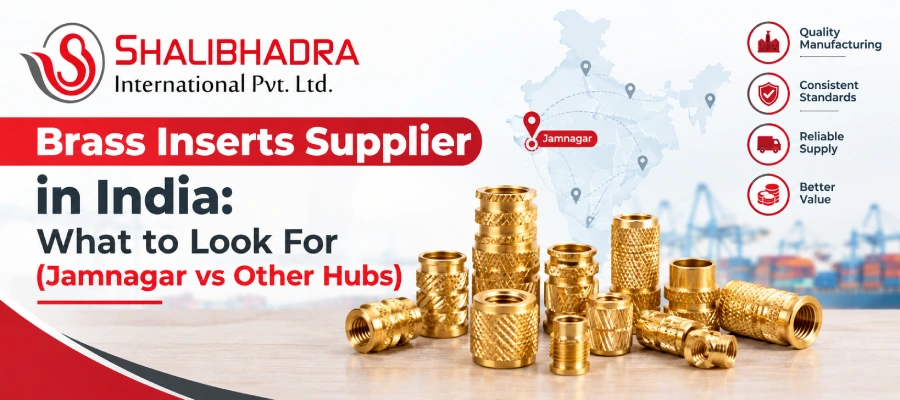
Location also shapes reliability, because India’s brass supply chain is concentrated in a few clusters. Jamnagar in Gujarat, often called the Brass City, houses thousands of small units that cast, forge and machine brass components. The cluster gives buyers quick access to rod, plating and tooling vendors, though quality varies widely from one workshop to the next.
A specialist and a general brass products supplier solve different problems. A general supplier may stock hex nuts, pipe fittings and cable glands under one roof, which is convenient for small orders. Threaded inserts for moulded plastics demand narrower tolerances and application knowledge, so a specialist usually gives better engineering support.
How Do Material Grade and Certifications Affect Quality?
Material grade decides how well an insert machines, holds threads and resists corrosion. The usual choice is free-cutting brass, known as C36000 in ASTM terms or CW614N in European standards, which carry about 57–63% copper and 2.5–3.7% lead for easy machining. Ask which grade a supplier uses and request the composition on paper.
Material test certificates separate serious suppliers from casual ones. A certificate in EN 10204 3.1 format links the batch to a spectrometer report from the mill, so you can verify copper, zinc and lead content. If a manufacturer cannot produce this within a day, the rod may have come from an unverified source.
Which Certifications Should You Ask For?
ISO 9001 is the baseline quality management certification, and IATF 16949 matters if the inserts go into automotive assemblies. Buyers exporting finished goods should also ask for RoHS and REACH compliance statements, since EU rules limit lead and other substances, with specific exemptions for lead in copper alloys up to 4% by weight.
Why Does Thread Quality and Tolerance Matter So Much?
Thread quality determines whether an insert holds or spins out of the plastic. Insert pull-out strength depends on knurl depth, thread class and the way the part is installed, so two inserts with identical dimensions can perform very differently. Request pull-out and torque test data on your own plastic, not a generic datasheet.
Tolerances on turned brass parts typically sit between ±0.02 mm and ±0.05 mm, depending on size and finish. Anything looser than ±0.1 mm on the outer diameter risks poor retention in moulded bosses. Ask the manufacturer for capability data, such as Cpk values on critical dimensions, and ask how often in-process checks are logged.
Insert style should match your assembly method. Heat-stake and ultrasonic inserts suit thermoplastics assembled after moulding, moulded-in inserts are placed in the mould before injection, and press-fit types suit rigid parts like die-cast housings. A good manufacturer will recommend a style from your drawing rather than push whatever sits in stock.
Plating and packaging protect the insert before it reaches your line. Plain brass suits most indoor electronics, while nickel plating adds corrosion resistance for humid or outdoor assemblies. Reputable producers such as [Brand Name] bag and label parts by batch number, which lets you trace any problem back to a specific production date.
What Should You Know About Pricing and Lead Times?
Unit price tells only part of the story, because brass is priced against copper and zinc, which move with global metal markets. Insist that every quote states a validity period, usually 15 to 30 days, and the raw material rate it assumes. Without that, a low quote can climb after you approve a sample.
Lead times for custom inserts usually split into two stages. Sample approval often takes 7 to 15 days, and production batches follow in roughly three to five weeks, depending on quantity and plating. Standard catalogue sizes ship faster, so check whether a supplier holds stock of common metric threads such as M3, M4, M5 and M6.
Minimum order quantities reveal how a manufacturer treats smaller buyers. Many Indian suppliers ask for 1,000 to 5,000 pieces per size on custom parts, though some negotiate lower for a first order. A manufacturer like [Brand Name] that publishes its sample policy and MOQ up front saves everyone several rounds of emails.
How Can You Vet a Supplier Before Placing an Order?
A short, structured vetting process catches most problems before money changes hands. Follow these five steps in order, and treat any skipped step as a risk you are choosing to carry.
- Share your drawing and ask for a feasibility reply within 48 hours.
- Request a material test certificate and ISO 9001 copy.
- Order 50 to 100 samples and run pull-out, torque and dimensional checks.
- Audit the plant or request a video walkthrough of machining and inspection.
- Place a small pilot order before committing to annual volumes.
Several warning signs should slow you down. A brass inserts manufacturer that quotes without seeing a drawing, refuses sample testing, or offers prices well below the market rate for copper-based alloys may be substituting lower-grade brass or recycled scrap. Delays in answering technical questions during the quoting stage tend to repeat during production.
Reference checks add the final layer of confidence. Ask for two customers in a similar industry and call them about delivery consistency and how the supplier handled rejections. A manufacturer confident in its work will hand over contacts without hesitation, and a vague answer says plenty.
FAQ
Free-cutting brass such as C36000 or CW614N is the standard choice because it machines cleanly and holds fine threads. Its copper-rich composition also resists corrosion in most indoor applications. Choose lead-free brass only if your end market, such as drinking water products, requires it.
Run dimensional checks with go/no-go thread gauges, then measure pull-out force and installation torque on your actual moulded part. Send a few samples to a lab for composition analysis if the supplier’s certificate looks doubtful. Testing 50 pieces usually reveals consistency problems.
Custom inserts commonly start at 1,000 to 5,000 pieces per size, while standard catalogue items may be available in hundreds. Some suppliers waive the MOQ for first trial orders. Always confirm whether tooling charges apply to custom knurl patterns.
Samples typically arrive within 7 to 15 days, and production runs take around three to five weeks. Stock items ship in a few days. Plating, special threads or tight tolerances can add a week or more.
Yes, though the insert style changes. Heat-stake, ultrasonic and moulded-in types go into plastics, while press-fit and self-tapping inserts suit softer metals such as aluminium and zinc die-castings. Always match hole size to the manufacturer’s installation guide.
The smartest next move is a small, controlled trial, not a big commitment. Pick two or three shortlisted suppliers, send each the same drawing, and compare their replies, samples and test data side by side. The differences in response speed and technical detail will tell you more than any brochure. Choosing a brass inserts manufacturer is ultimately a bet on consistency, and a bet worth testing cheaply. Start with a sample order this week, log every measurement, and let the numbers decide. If you want a reference point for what thorough documentation looks like, ask [Brand Name] for its sample test report and use it as your benchmark.