
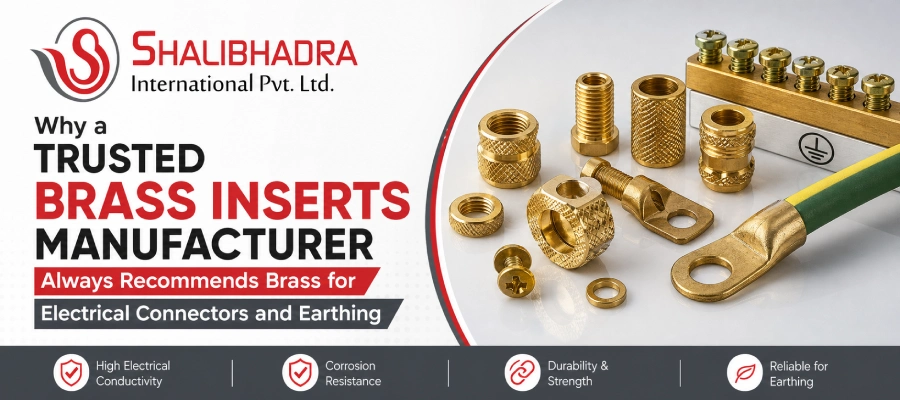
Electrical systems fail quietly, long before anyone notices a spark or a tripped breaker. Loose connections, corroded terminals, and weak earthing paths build up resistance over months, and by the time the fault shows up, the damage is already done. This is exactly why the material behind a connector matters as much as its shape or size, and why any experienced brass inserts manufacturer will tell you the metal choice is the first decision, not an afterthought.
This piece walks through why brass has held its place in connectors and earthing components for decades, how it stacks up against copper and aluminium, and what actually separates a dependable brass inserts supplier from one that is simply moving stock.
Brass earns its role in electrical hardware through a specific mix of properties: it conducts electricity efficiently, resists corrosion far longer than plain steel, and machines into precise threads without cracking. A brass inserts manufacturer typically works with alloys carrying 60 to 70 percent copper, which keeps conductivity high while zinc content adds the strength connectors need to survive repeated tightening.
What Makes Brass Ideal for Electrical Connectors
Brass conducts electricity well enough for practical use while offering something copper alone cannot match at scale: dimensional stability under mechanical stress. A connector gets threaded, torqued, vibrated, and reheated over its working life, and brass tolerates that cycle without deforming or loosening on its own.
Corrosion resistance is where brass separates itself from cheaper alternatives. The copper-zinc alloy forms a thin oxide layer on exposed surfaces that actually protects the metal underneath, rather than flaking away like rust does on untreated steel. That layer is why brass terminals installed decades ago in older buildings still test within acceptable resistance ranges today.
Machinability matters just as much as conductivity for anyone sourcing from a brass products supplier. Brass cuts cleanly on high-speed lathes, holds tight thread tolerances, and does not gum up tooling the way softer metals sometimes do. That translates into connectors with consistent fit, which matters enormously when a single loose pin insert can raise contact resistance and generate heat at a joint.
Cost also plays a quiet but real role. Brass sits well below silver and often below pure copper alloys on a per-kilogram basis, while still delivering conductivity in the range of 28 percent IACS or higher depending on the specific alloy grade. For high-volume connector production, that difference adds up across millions of units.
How Does Brass Compare to Copper and Aluminium in Connectors?
Pure copper conducts better than brass on paper, sitting near 100 percent IACS against brass alloys typically in the 20 to 30 percent range. But raw conductivity is only one variable in a connector, and copper’s softness works against it once threading, crimping, and repeated use enter the picture.
Aluminium brings weight and cost advantages, which is why it shows up in overhead power lines and some large-scale wiring runs. Its drawback is a stubborn oxide layer that forms almost instantly on exposed surfaces, increasing resistance at joints unless the connection uses specialized anti-oxidant compounds and larger contact areas.
| Property | Brass | Copper | Aluminium |
| Conductivity (%IACS) | 20-30 | ~100 | ~61 |
| Corrosion resistance | High | Moderate | Low without treatment |
| Machinability | Excellent | Fair | Good |
| Typical cost per kg | Moderate | High | Low |
| Common use | Connectors, inserts, earthing pins | Wiring, busbars | Overhead lines, large cables |
The table shows why brass sits in the middle deliberately. It gives up some raw conductivity to gain mechanical durability, corrosion resistance, and manufacturing precision, which is exactly what a threaded connector or an earthing pin needs more than a length of cable does.
Why Do Earthing Systems Rely on Brass Components?
Earthing depends on a low-resistance path staying intact for years, often buried underground or exposed to moisture, and brass handles both conditions better than most alternatives. Earthing rods, clamps, and connector plates made from brass resist the gradual pitting corrosion that would otherwise raise the resistance of the entire grounding path over time.
Underground and outdoor installations expose components to soil chemistry, humidity, and temperature swings that would corrode untreated steel within a handful of years. Brass earthing components routinely stay functional for 15 to 25 years in the same conditions, based on field replacement data reported by electrical contractors working on industrial sites.
A reliable brass inserts supplier also accounts for standards compliance here, since earthing hardware in most markets needs to meet specifications such as IS 3043 in India or IEC 62561 internationally. These standards set minimum cross-sectional area and material purity requirements precisely because a weak earthing path turns a minor fault into a serious safety hazard.
Manufacturing Standards Behind Reliable Brass Inserts
Consistency in alloy composition separates a dependable manufacturer from one producing hit-or-miss batches. Reputable production runs test each lot for zinc-to-copper ratio, since even a five percent deviation changes both conductivity and how the metal behaves under a lathe.
Thread precision determines whether an insert actually grips the material it is molded or pressed into. Manufacturers producing to tolerances within a few microns prevent the insert from spinning loose inside plastic housings, a failure mode that shows up as intermittent connections months after installation.
Surface finishing adds a second layer of protection beyond the natural oxide barrier. Nickel or tin plating over brass connectors is common in applications facing higher humidity or salt exposure, extending service life well beyond what bare brass alone would achieve in coastal or industrial environments.
Batch testing for tensile strength and torque resistance catches problems before they reach a customer’s assembly line. A connector insert that strips out under normal installation torque is a design and quality failure, not a user error, and testing at the source is the only way to prevent it from happening downstream.
Choosing the Right Brass Inserts Manufacturer for Your Project
Certifications tell you more than a sales pitch ever will. Look for ISO 9001 quality management certification at minimum, and for earthing-specific components, confirm the manufacturer tests against the relevant national or IEC earthing standard rather than a generic material spec.
Sample testing before a bulk order protects against costly surprises. Request a small batch, check dimensional tolerance with calipers, and if possible, run a basic conductivity or salt-spray corrosion test rather than relying on a datasheet alone.
Production capacity and lead time consistency matter more than headline pricing for B2B buyers running ongoing production lines. A brass products supplier quoting the lowest price but missing delivery windows by weeks creates downstream costs that outweigh any per-unit savings.
Traceability rounds out the list of practical checks. Ask whether raw material batches are documented and whether finished components carry lot numbers, since this becomes critical if a field failure ever needs root-cause investigation months or years after installation.
FAQ
Brass is not more conductive than copper, but it holds threads, resists corrosion, and machines more precisely, which makes it the better structural choice for connector bodies and inserts rather than for the conductive wire itself.
Most earthing hardware uses free-cutting brass alloys such as CuZn39Pb3 or similar copper-zinc-lead compositions, chosen because they balance machinability with the corrosion resistance needed for long-term outdoor and underground exposure.
Field data from industrial installations generally shows a service life of 15 to 25 years for properly specified brass earthing rods and clamps, depending on soil conditions, moisture levels, and whether the components carry additional plating.
Bare brass performs reasonably well outdoors due to its natural oxide layer, but in coastal areas or high-pollution environments, nickel or tin plating extends service life significantly and is worth the marginal added cost.
An established supplier controls alloy consistency, thread tolerance, and testing at the source, while a general trader is often reselling stock without visibility into any of those variables, which shows up later as inconsistent batches.
Brass did not become the standard in connectors and earthing hardware by accident. It earned that position through decades of field performance that copper’s higher conductivity and aluminium’s lower cost never quite managed to displace. The next time a project spec calls for connector inserts or earthing components, the more useful question is not which metal sounds best on paper, but which manufacturer can prove consistency batch after batch. That single check saves more downstream cost than any material comparison alone ever will.