
A single bad batch of threaded inserts can shut down an assembly line for days. That’s the real cost buyers rarely factor in when they compare price sheets from a brass inserts manufacturer against another the damage isn’t in the invoice, it’s in the downtime, the rejected parts, and the client calls nobody wants to make. Choosing the right partner for this component category is less about finding the lowest quote and more about finding a supplier whose process you can actually trust at scale.
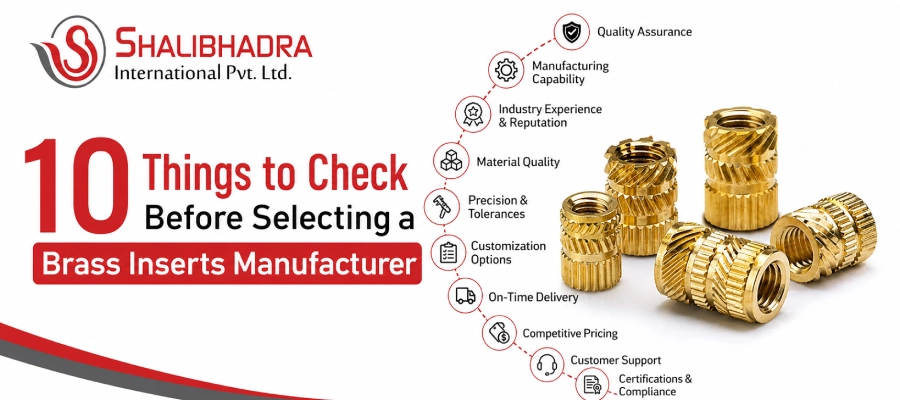
This piece walks through the ten checks worth running before you sign a purchase order, written for procurement teams, OEM buyers, and manufacturing managers who need brass inserts to perform the same way on unit one and unit ten thousand.
A reliable brass inserts manufacturer is one that controls raw material sourcing, holds tight dimensional tolerances (typically within 0.02mm to 0.05mm), tests every batch for hardness and plating adhesion, and can document traceability from billet to finished part. Buyers who verify these four areas upfront avoid most quality failures downstream.
1. Raw Material Traceability
Every brass insert starts as a rod or billet, and the alloy composition decides how the part performs under heat, torque, and repeated insertion cycles. A manufacturer that can’t name the brass grade – usually C36000 free-cutting brass or C26000 cartridge brass for insert applications – is a manufacturer guessing at consistency.
Ask for mill certificates on the raw material batch used for your order. This single document tells you the copper-zinc ratio, lead content where relevant, and whether the supplier is buying from a certified mill or from unverified scrap-recycled stock, which behaves unpredictably during machining.
2. Manufacturing Process and Equipment
Brass inserts get made two main ways: CNC turning from bar stock, or hot forging followed by machining for larger or load-bearing inserts. The method changes grain structure, strength, and cost, so the right choice depends on your application, not on whatever the factory already has running.
A brass parts supplier in India with a mixed shop floor – CNC lathes for high-volume precision work and forging capacity for heavier inserts – gives buyers flexibility without needing to split orders across two vendors. Ask to see the machines, not just photos of finished parts.
How Does Tolerance Control Affect Insert Performance?
Tolerance is where most insert failures actually originate, and it’s rarely visible until the part is already in an assembly. An insert that’s 0.03mm oversized won’t seat correctly in a molded plastic housing; one that’s undersized loses pull-out strength and can spin loose under torque.
Ask any brass inserts manufacturer for their tolerance range on the specific insert type you need, not a generic company-wide figure. Serious manufacturers hold external diameter tolerances around ±0.02mm to ±0.05mm and will show you inspection reports with actual measured values against your drawing, not just a pass/fail stamp.
3. In-House Quality Testing Capability
Testing shouldn’t happen only at final inspection. Reputable manufacturers run checks at multiple stages – incoming material, mid-process dimensional sampling, and final batch testing – because catching a deviation early costs far less than scrapping a finished lot.
Look specifically for hardness testing (Rockwell or Vickers), plating thickness measurement using X-ray fluorescence, and pull-out force testing for threaded and knurled inserts. A supplier that can hand you a test certificate with actual numbers, not a generic compliance letter, is one worth continuing to work with.
4. Plating and Surface Finish Options
Most brass inserts ship with a surface treatment – nickel plating for corrosion resistance, tin plating for solderability in electronics, or passivation for outdoor applications. The wrong finish for your environment shortens the part’s working life regardless of how well the base metal was machined.
A capable brass inserts supplier will ask about your end-use environment before recommending a finish, rather than defaulting to whatever plating line is cheapest to run that week. Humidity exposure, contact with dissimilar metals, and assembly temperature all change which coating actually holds up.
Can One Supplier Handle Both Prototyping and Volume Production?
This question matters more than buyers usually realize, because switching manufacturers between prototype approval and mass production often means re-validating tolerances, finishes, and performance all over again. That re-validation cycle can add four to six weeks to a project timeline.
Manufacturers set up for both stages typically maintain a smaller CNC cell for sample runs of 50 to 500 pieces alongside dedicated production lines for orders in the tens of thousands. Confirm this capacity split during your first factory conversation, before committing to a prototype run.
5. Order Flexibility and Lead Time Transparency
Lead times for brass inserts commonly run two to four weeks for standard sizes and six to eight weeks for custom tooling, but the number that matters more is how consistently a supplier hits the date they quote. A manufacturer who is honest about a longer lead time is more useful than one who promises fast delivery and misses it.
Ask for their on-time delivery rate over the past twelve months, and ask what happens contractually if that date slips. Vague answers here usually predict vague answers on quality issues later.
6. Documentation and Export Compliance
For buyers sourcing internationally, documentation isn’t paperwork – it’s the thing that gets your shipment through customs without delay. RoHS compliance certificates, material safety data sheets, and country-of-origin documentation should be available on request, not something the manufacturer needs a week to produce.
A brass parts supplier in India exporting to markets like the US or EU should already have these documents templated and ready, since repeat exporters build this into their standard order process rather than treating it as a special request.
7. Communication and Technical Support
The quality of pre-sale communication is a fair predictor of post-sale support. A manufacturer whose engineering team asks clarifying questions about your torque requirements, insertion method, and mating material is one that’s thinking about your application, not just cutting metal to a print.
Compare how quickly technical questions get real answers versus generic sales responses. If getting a straight answer about tolerance or material takes three follow-up emails before you’ve even placed an order, that pattern rarely improves afterward.
8. Minimum Order Quantities and Scalability
MOQs vary widely across brass inserts manufacturer options, from a few hundred pieces for standard catalog sizes to several thousand for custom geometries requiring dedicated tooling. Buyers scaling from prototype to full production need a partner whose MOQ structure grows with them instead of forcing a jump to a new vendor at volume.
Confirm pricing tiers at multiple quantity breaks upfront – 1,000, 10,000, and 100,000 units, for example – so cost planning for next year isn’t a guessing game today.
FAQ
Most precision brass inserts hold external diameter tolerances between ±0.02mm and ±0.05mm, though this narrows for high-load or medical-grade applications. Always confirm the exact figure against your specific drawing rather than a general company claim.
Request ISO 9001 documentation along with recent third-party audit reports, and cross-check the certificate number against the issuing body’s public database. A legitimate certification will always be verifiable independently, not just presented as a scanned image.
A manufacturer produces the parts in-house with direct control over material and process, while a supplier may source from multiple factories and resell. Manufacturers typically offer more customization and tighter quality traceability, while suppliers can offer wider catalog variety.
New tooling for a custom brass insert design typically takes three to five weeks, depending on geometry complexity and whether it requires forging dies or purely CNC programming. Simple modifications to existing tooling can often be turned around in under two weeks.
Established brass parts supplier operations in India, particularly in manufacturing hubs like Jamnagar, combine lower production costs with ISO-certified processes that meet international automotive and electronics standards. Buyers should still audit individual factories rather than assuming quality by region alone.