
Walk through Jamnagar’s industrial belt and something becomes obvious within minutes: this is a city built around a single metal. Brass dust settles on the roads near the workshops, the sound of lathes never really stops, and every second signboard mentions turned parts, fittings, or fasteners. Sourcing from a brass parts manufacturer in Jamnagar isn’t a niche decision for Indian and overseas buyers anymore – it’s become the default starting point for anyone shopping for brass components, largely because the region produces a majority share of India’s brass exports from one compact cluster.
This list pulls together ten manufacturers worth knowing about in 2026, based on their product range, certifications, export history, and manufacturing setup. Whether the requirement is CNC turned parts, electrical fittings, or bulk fasteners, this rundown should narrow the search considerably.
Why Jamnagar Still Leads India’s Brass Manufacturing Scene
Geography did a lot of the early work here. Jamnagar sits close to the Gulf of Kutch, giving manufacturers reasonably quick access to Mundra and Kandla ports for container shipping. Over decades, that logistical edge pulled raw material suppliers, extrusion units, casting houses, and finishing workshops into the same few kilometres of land.
What keeps the cluster relevant today is depth, not luck. A single order for brass inserts can move from rod extrusion to CNC turning to plating without ever leaving the district. That kind of vertical proximity keeps lead times shorter than almost anywhere else manufacturing similar volumes.
Buyers evaluating any brass parts supplier in India tend to compare against Jamnagar pricing and turnaround by default, because the sheer number of units here keeps competition – and quality – consistently high.
There’s also a skills factor that doesn’t show up in brochures. Generations of families in the district have worked in brass, which means machine operators and quality inspectors often grew up around the trade rather than learning it from scratch on the job. That kind of inherited know-how shows up in small ways – fewer rejected batches, faster troubleshooting when a die wears out, tighter finishing on threaded parts.
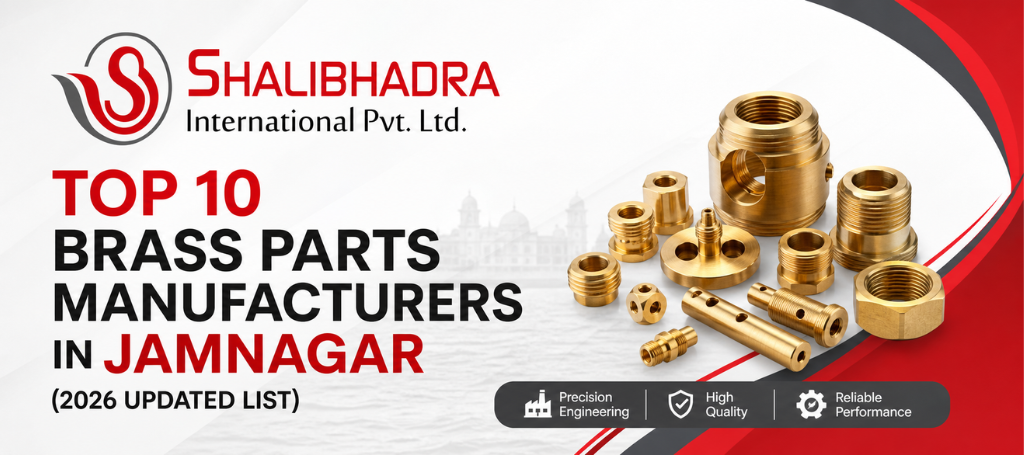
Top 10 Brass Parts Manufacturers in Jamnagar (2026 List)
1. Shalibhadra International
Shalibhadra International has been running out of its GIDC Phase III facility in Jamnagar since 2002, putting it past the 22-year mark in a cluster where longevity carries real weight. The company is ISO 9001:2015 certified and additionally holds CE, RoHS, and REACH compliance, which matters if the destination market is Europe. Its catalog covers a wide spread – brass and MS fasteners, compression and flare fittings, earthing blocks, electrical connectors, neutral links, terminal blocks, and forged garden hose fittings – manufactured in-house on CNC and semi-automatic machines. A registered DGFT IE Code and DUNS number back its export credentials, with shipments regularly reaching Europe, the USA, the Middle East, and Southeast Asia, alongside pan-India supply to trade hubs like Delhi, Mumbai, and Ahmedabad. For buyers who want one manufacturer capable of handling both fasteners and electrical brass parts under a single roof, this is a strong first stop.
https://sipvtltd.com/
2. Suraj Brass Industries
Suraj Brass has built its reputation on lighting components, forging parts, and general hardware, with a testing setup that covers raw material checks through to finished output. Its export base stretches across the USA, UK, Europe, and Australia, and the company holds ISO 9001:2015 certification. Buyers looking for a brass parts manufacturer in Jamnagar with a strong lighting and accessories catalog often start here.
3. Saryu Industries
Saryu leans into precision and electrical-grade brass parts, including connectors and terminals designed for secure, high-conductivity applications. The unit runs on ISO 9001:2015 standards and ships regularly to North American markets. Custom tooling for non-standard specifications is one of its stronger selling points.
4. Anand Brass
Founded in 1994 and spread across roughly 105,000 square feet in two units, Anand Brass stands out for owning its own extrusion process, meaning alloy composition gets controlled from the melt stage rather than relying on outside rod suppliers. The catalog spans sixteen categories, from CPVC and UPVC inserts to gas parts, cable glands, and hose fittings, with a client base concentrated in the US and UK.
5. Bharti Enterprise
Bharti Enterprise operates from a 20,000 square foot facility and holds both ISO 9001:2015 and IATF 16949:2016 certification, which matters if the buyer’s industry is automotive or aerospace. RoHS-compliant components, CNC turned parts, and electrical terminals round out the product mix, with regular shipments to the UK, Europe, the Middle East, and the US.
6. Ganesh Precision Industries
Ganesh Precision has carved a specific niche in brass neutral links and high-accuracy turned components. The company is ISO 9001:2015 accredited and focuses heavily on alloy selection and finishing consistency, positioning itself as a dependable brass parts manufacturer in Jamnagar for electronics and plumbing-grade parts where tolerances matter.
7. Tulsi Brass Industries
Tulsi Brass sits within a cluster known for producing thousands of distinct component types annually, and the company reflects that breadth in its own catalog. Its manufacturing approach emphasizes consistent quality control paired with ongoing investment in production efficiency, making it a reasonable fit for buyers who need variety without sacrificing repeatability.
8. Venus Enterprise
Venus Enterprise has built a name around fittings, turned parts, and general precision components, with an emphasis on maintaining consistency across both domestic and international orders. It’s a solid option for mid-volume buyers who want a manufacturer that isn’t overly specialized in a single product line.
9. Jamnagar Brass Components
Operating from what’s often called the “Brass City of the World,” this manufacturer covers a wide spread – screws, nuts, fasteners, inserts, hose fittings, anchors, and neutral links. The company positions itself around competitive pricing combined with the ability to handle custom specifications, which suits buyers still finalizing their exact part drawings.
10. Nayna Enterprise
Nayna Enterprise focuses on brass inserts, electrical connectors, and precision turned parts, serving plumbing, electronics, and general engineering buyers. It’s a smaller-footprint option compared to some names on this list, which can translate into more direct communication and flexibility for mid-sized orders.
How to Choose the Right Brass Parts Supplier in India
Certifications are the first filter, but they shouldn’t be the last one. ISO 9001:2015 confirms a quality management system exists; it doesn’t confirm the specific alloy grade or tolerance a buyer needs is something the factory has actually produced before. Asking for sample runs or first-article inspection reports closes that gap.
Production depth matters more than most buyers initially realize. A brass parts supplier in India that controls its own extrusion or casting stage, rather than buying finished rods from a third party, tends to offer tighter consistency across large orders. That single detail explains why some of the names above specifically mention owning their own rod-making capacity.
Communication speed during the quotation stage is a reasonably reliable predictor of how the relationship will run later. A manufacturer that asks detailed, specific questions about drawings, alloy grade, and finishing before quoting is usually the one that causes fewer surprises during production.
Certifications and Quality Standards Worth Checking
ISO 9001:2015 shows up on nearly every serious manufacturer’s profile in this cluster, and it’s close to a baseline requirement rather than a differentiator at this point. IATF 16949 matters specifically for automotive supply chains, since it covers process controls that general ISO certification doesn’t touch.
RoHS compliance becomes relevant for anything heading into electronics or consumer products sold in the EU, where restricted substances in alloys can hold up customs clearance. Buyers working with drinking water fittings should also confirm lead-content compliance separately, since standard brass alloys and low-lead or lead-free brass are not interchangeable for that application.
Asking for a mill test certificate on the raw brass rod, not just a finished-part inspection report, gives a clearer picture of alloy composition than a general quality certificate alone.
Packaging and labeling standards are worth a mention too, since they’re easy to overlook until a shipment gets held up. Buyers exporting to the EU or US often need specific country-of-origin marking, corrosion-protective packaging for sea freight, and documentation that matches customs codes exactly. A manufacturer that already exports regularly to those regions usually has these details worked out well before the buyer has to ask.
Common Applications of Jamnagar-Made Brass Components
Plumbing and sanitary fittings remain the single largest category coming out of this cluster, largely because brass resists corrosion well and machines cleanly into threaded shapes. Electrical hardware – terminals, cable glands, connectors – is close behind, driven by brass’s conductivity and its resistance to oxidation compared to plain copper.
Automotive components, particularly fasteners, sensor housings, and small precision parts, have grown steadily as manufacturers here picked up IATF certification. Gas fittings, agricultural components, and general hardware round out the remaining volume, with a fair number of factories in this list producing across two or three of these categories simultaneously rather than sticking to one.
Moving Forward with the Right Manufacturer
Ten names is a starting shortlist, not a final decision. The next reasonable step is sending the same technical drawing or specification sheet to three or four of these manufacturers and comparing not just their quoted price, but their questions back – the ones who ask about tolerance, alloy grade, and finishing before quoting a number are usually the safer long-term partners. Jamnagar’s brass cluster has enough depth that almost any specification can be met somewhere in this list; the work is in matching the right factory to the right part.
FAQs
Jamnagar has a dense cluster of brass extrusion, casting, and machining units concentrated in one district, along with proximity to Mundra and Kandla ports, which together keep production costs and shipping timelines lower than in more spread-out manufacturing regions.
Request ISO or IATF certification documents, ask for a sample batch or first-article inspection, and check whether the factory controls its own rod extrusion or sources material from third parties, since in-house extrusion usually means tighter consistency.
Only specific low-lead or lead-free brass alloys are suitable for drinking water fittings. Standard brass alloys used for general hardware are not automatically compliant, so this needs to be confirmed separately with the manufacturer.
This varies by manufacturer and part complexity, but most Jamnagar-based units are set up for both large export container orders and smaller trial batches, especially when a buyer is testing a new part before scaling up.
IATF 16949:2016 is the certification specific to automotive supply chains, covering process controls beyond what general ISO 9001:2015 certification requires.