
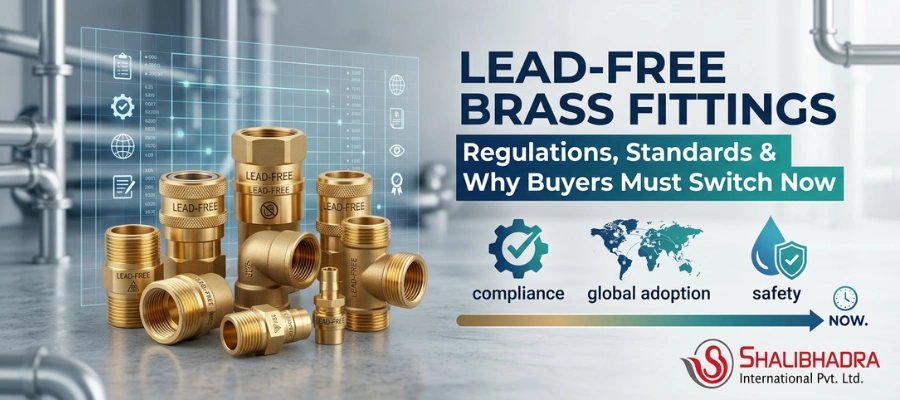
Quick Summary: Lead-free brass fittings are no longer just a “nice to have.” From the US Safe Drinking Water Act to the EU’s 2026 Positive List, regulations are tightening across every major export market. If you source or manufacture brass fittings for plumbing, construction, or water systems – this guide covers everything you need to know to stay compliant, protect your buyers, and stay ahead of the curve.
Table of Contents
- What Are Lead-Free Brass Fittings?
- Why Lead in Brass Was Ever Used (And Why That’s Changing)
- Global Regulations You Must Know Right Now
- Key Certifications & Standards Explained
- Lead-Free Alloys: What Replaces Lead in Brass?
- Industries That Must Switch – And Why
- What to Look for in a Lead-Free Brass Products Supplier Factory India
- How a Certified Brass Products Manufacturing Factory Supports Your Compliance
- Common Buyer Questions – Answered Honestly
- The Bottom Line: Switch Now, Not Later
What Are Lead-Free Brass Fittings?
Let’s start with the basics – because there’s more nuance here than most people realise.
Lead-free brass fittings are brass components manufactured from alloys that contain no more than 0.25% lead by weighted average across all surfaces that come into contact with water. This is not a marketing claim. It is a precise, legally enforceable definition established by the US Safe Drinking Water Act (SDWA), Section 1417.
To put that number in context: traditional brass alloys – like the widely used CDA 360 – contain between 2.5% and 3.7% lead. That lead was added deliberately. It makes brass easier to machine, reduces tool wear, and lowers production costs. For decades, it was considered completely acceptable.
Today, that’s changed – and for very good reason.
Research has confirmed that lead can leach from brass fittings into standing drinking water, especially during “first draw” conditions (the first water that flows from a tap that has been sitting idle). Studies show that standard leaded brass fittings with 3% lead can release 10–200 micrograms of lead per litre of water – far above the World Health Organisation’s guideline of 10 µg/L and the US EPA action level of 15 µg/L.
There is no safe level of lead exposure for human beings. For children, even trace exposure can affect brain development. The science is settled. The regulations have followed.
Why Lead in Brass Was Ever Used (And Why That’s Changing)
If you’re a buyer or procurement manager, you might wonder – why was lead in brass fittings ever allowed in the first place?
Fair question. Here’s an honest answer.
Lead improves what engineers call “machinability.” It acts like a built-in lubricant inside the alloy, causing brass to break into clean chips during CNC turning and drilling rather than producing long, stringy swarf that clogs machines. It also reduces tool wear significantly – a real cost advantage in high-volume manufacturing.
For most of the 20th century, brass fittings were used in heating systems, gas lines, and irrigation – applications where the water was never consumed. In those contexts, a small amount of lead in the alloy was genuinely harmless.
The problem emerged as the same fittings began appearing in potable (drinking) water systems – household plumbing, water meters, kitchen tap fittings – where water sits in contact with metal before being drunk.
Today, with awareness of lead toxicity at an all-time high and with regulatory bodies in the US, EU, UK, and Australia all tightening the rules simultaneously, the shift to lead-free brass is no longer a future consideration. It is the present reality for any serious brass products manufacturing factory serving global markets.
Global Regulations You Must Know Right Now
This section is perhaps the most important one if you are an international buyer, contractor, or distributor. Regulations vary by country – and getting this wrong can mean rejected shipments, failed inspections, or legal liability.
United States – SDWA Section 1417 & AB 1953
The US federal definition of “lead-free” for potable water components has been 0.25% maximum weighted average lead since January 2014, under the Reduction of Lead in Drinking Water Act. This applies to all pipes, pipe fittings, plumbing fittings, and fixtures used in systems that provide water for human consumption.
California went even further, earlier. California AB 1953 (effective 2010) was the first state-level legislation to enforce the 0.25% standard, and it effectively became the benchmark that pushed the federal government to follow suit. For any manufacturer or supplier targeting the US market, California compliance is the floor – not the ceiling.
Products used exclusively in non-potable applications (irrigation, industrial processing, outdoor use where water is not consumed) are exempt from these requirements.
European Union – RoHS, REACH & the 4MS Positive List
The EU uses a multi-regulation framework for lead in brass fittings:
- RoHS Directive (2011/65/EU): Restricts hazardous substances including lead in electrical and electronic equipment. Traditional brass is covered under Annex 6(C), which allows up to 4% lead – but this exemption is under active review and may be tightened.
- REACH Regulation: Governs chemical safety, including restrictions on substances of very high concern (SVHC) in articles. Lead in brass components used in consumer-facing products increasingly falls under REACH scrutiny.
- 4MS Positive List (2026): This is the most urgent development for manufacturers right now. The four major European markets – Germany, France, Netherlands, and the UK – are aligning on a harmonised Positive List of approved materials for drinking water contact. New plumbing products across the EU must comply with this list. Alloys like CW724R and CW511L are listed as compliant; traditional CW614N (standard leaded brass) is not.
United Kingdom – WRAS Approval
Post-Brexit, the UK maintains its own framework. The Water Regulations Advisory Scheme (WRAS) tests products for leaching compliance and issues WRAS Approval Marks. For any product going into UK potable water installations, WRAS approval is effectively mandatory for serious buyers and specifiers.
Australia & New Zealand – WaterMark
The WaterMark Certification Scheme, administered by the Australian Building Codes Board (ABCB), is mandatory for plumbing and drainage products sold in Australia and New Zealand. It requires compliance with AS/NZS 4020 (chemical safety) and ongoing factory audits – not just one-time product testing.
The takeaway for buyers: if your supply chain touches any of these markets, you cannot afford to source brass fittings that aren’t lead-free compliant. The era of “we’ll sort the compliance later” is over.
Key Certifications & Standards Explained
Certifications can feel like alphabet soup. Here is a clear, plain-language guide to what actually matters.
NSF/ANSI/CAN 61 – The Foundational Health Effects Standard
NSF 61 certifies that a product does not leach harmful contaminants into drinking water. It’s a performance standard – it tests what comes out of the water that passes through the fitting, not what the fitting is made of. Products must pass NSF 61 to be considered safe for potable water contact in North America.
NSF/ANSI/CAN 372 – The Lead Content Standard
NSF 372 specifically verifies that the weighted average lead content across wetted surfaces is 0.25% or less. This is tested using XRF (X-ray fluorescence) screening and ICP-MS (mass spectrometry) analysis. Products must pass both NSF 61 and NSF 372 together to be considered fully lead-free compliant for US and Canadian markets.
cUPC Certification – Canada + US in One
cUPC certification from IAPMO (International Association of Plumbing and Mechanical Officials) indicates compliance with both US and Canadian plumbing codes. The “c” prefix covers Canada specifically. A single cUPC certification opens doors to both markets – a real efficiency advantage for manufacturers.
WRAS – UK Compliance
WRAS approval involves independent leaching tests, and the scheme maintains a publicly searchable database of approved products. UK buyers and specifiers routinely check this database before placing orders.
What Certification Labels to Look For on Products
When sourcing from any brass products supplier factory India or internationally, ask specifically for:
- NSF 61 + NSF 372 certificates (for US/Canada)
- WRAS Approval Number (for UK)
- WaterMark Licence Number (for Australia/NZ)
- RoHS Declaration of Conformity + REACH statement (for EU)
- EN 10204 3.1 Material Test Certificates confirming Pb ≤ 0.09% (for CW724R alloy)
A credible supplier will provide all of this without hesitation.
Lead-Free Alloys: What Replaces Lead in Brass?
This is where the engineering gets interesting – and where the quality of your chosen brass products manufacturing factory really matters.
Since lead cannot simply be removed from brass without affecting machinability, engineers have developed substitute alloys that provide similar performance characteristics. The main ones in use today are:
Silicon Brass – CW724R (C69300)
Silicon brass is currently the most widely accepted lead-free alloy for drinking water fittings in both North America and Europe. It replaces lead with silicon, which provides excellent machinability and corrosion resistance. CW724R is pre-listed on the EU 4MS Positive List and is NSF 372 compliant. It machines slightly differently from traditional leaded brass – requiring cutting speeds and tool geometries tuned for the alloy – but modern CNC machining centres handle it well.
Bismuth Brass
Bismuth acts as the closest substitute for lead in terms of machinability. Bismuth-brass alloys can achieve almost identical chip-breaking behaviour to leaded brass. However, bismuth has hot-shortness limitations – it can be brittle at elevated temperatures – which restricts its use in hot-forged components like elbows and tee fittings. It is better suited to CNC-turned parts.
DZR Brass – CW602N
Dezincification-resistant brass (DZR) is not strictly a “lead-free” alloy by the 0.25% definition, but it offers significantly improved corrosion resistance compared to standard leaded brass, and some formulations are RoHS compliant. It is widely used in the UK and European plumbing markets where dezincification is a known failure mode.
C27450 (UNS)
Used by manufacturers like Dixon Valve for their “LF” (Lead-Free) product line, C27450 contains less than 0.25% lead and meets NSF/ANSI 61 requirements. It is a good all-purpose alloy for fittings, valves, and connectors.
Understanding which alloy is correct for your specific application – and verifying that your supplier is actually using that alloy consistently – is one of the most important decisions a procurement team can make.
Industries That Must Switch – And Why
Lead-free compliance is not equally urgent for everyone. But these sectors have either already crossed into mandatory territory or are very close to it.
Residential & Commercial Plumbing
If fittings, valves, ball valves, or compression fittings will touch potable water anywhere in their service life – in a home, an apartment building, a hotel, a hospital, a school – lead-free compliance is non-negotiable in the US, UK, Australia, and increasingly in Europe. No reputable contractor will accept non-compliant fittings on a potable water job.
Municipal Water Infrastructure
Water utilities in the US and Europe are under intense regulatory and public scrutiny following crises like Flint, Michigan. Procurement specifications for municipal projects now routinely mandate NSF 61 + 372 certified components. A brass products supplier factory India that cannot provide these certifications will be disqualified from the bidding process outright.
HVAC & Building Services
Many modern HVAC systems include potable water connections or are part of integrated building water systems. Contractors specifying materials for LEED-certified or BREEAM-rated buildings are required to use lead-free components as part of their sustainability compliance.
Food & Beverage Processing
Any brass component that comes into contact with water used in food production, beverage manufacturing, or pharmaceutical processing must meet lead-free standards – and typically much stricter ones than the 0.25% limit.
Export-Oriented Manufacturers
If you manufacture any product that will be shipped to the US, EU, UK, Canada, or Australia and contains brass water-contact components, you are already operating in a lead-free compliance environment whether you have addressed it or not. The time to get compliant is before the shipment – not at the port of entry.
What to Look for in a Lead-Free Brass Products Supplier Factory India
India – and particularly Jamnagar, Gujarat – is home to the world’s most concentrated ecosystem of brass manufacturing expertise. Over 5,000 brass manufacturing units operate in Jamnagar alone, producing an estimated 60–65% of India’s total brass output, with exports to 80+ countries.
But not all of them have made the transition to lead-free production. Here is exactly what to look for when evaluating any brass products supplier factory India for lead-free fittings:
1. Material Certification First
Ask for EN 10204 3.1 Material Test Certificates for every batch. These certificates, issued by accredited laboratories, confirm the chemical composition of the alloy – including lead content – and are traceable to the specific production lot.
2. Third-Party Product Certification
NSF 61/372 certificates, WRAS approvals, and WaterMark licences should be issued by accredited third parties – not self-declared by the manufacturer. Ask to see the certificate number and verify it against the certifying body’s online database.
3. Dedicated Lead-Free Production Lines
In a facility that also produces standard leaded brass components, cross-contamination is a genuine risk. Ask whether the manufacturer runs dedicated lead-free lines with separate raw material stores, or whether they produce leaded and lead-free parts on the same machines.
4. Export Documentation Capability
Particularly for US-bound shipments, you will need accurate commercial invoices, packing lists, Certificate of Origin (COO), and customs documentation that correctly declares the alloy composition. A good brass products manufacturing factory will handle this routinely.
5. Consistent Quality Systems
Look for ISO 9001 certification as a baseline. Better still, ask about their internal quality control processes – incoming material inspection, in-process XRF checks, and final dimensional inspection before shipment.
How a Certified Brass Products Manufacturing Factory Supports Your Compliance
Here is something that often surprises buyers who are new to international sourcing: your supplier’s compliance is your compliance.
If a regulator, inspector, or end-customer challenges the lead content of a product in your supply chain, you will be asked to produce documentation tracing the material back to its source. A good brass products manufacturing factory doesn’t just supply parts – it supplies the paperwork trail that protects you.
This means:
- Full material traceability from billet to finished component
- Batch-level test certificates available on request
- Willingness to accommodate third-party audits of their facility
- Proactive updates when alloy standards or certification requirements change
The best factories in Jamnagar operate like genuine manufacturing partners, not just component vendors. They understand that their buyers are accountable to regulations they may not fully see – and they build their quality systems to support that accountability.
Common Buyer Questions – Answered Honestly
“Does switching to lead-free brass cost more?”
Yes, in some cases – but less than you might expect. Lead-free alloys like silicon brass typically carry a modest material cost premium (5–15% depending on alloy and volume). However, this is partially offset by longer tool life in some alloys, and almost entirely offset by the cost of non-compliance – which includes rejected shipments, failed project inspections, and potential liability.
“Can I use standard brass for non-potable applications?”
Yes. The lead-free requirement in the US and most other markets explicitly exempts products used exclusively for non-potable services such as industrial processing, irrigation, outdoor watering, and fire suppression (with some nuances). If the water is never consumed by humans, standard brass remains compliant.
“How do I verify that what I receive is what was certified?”
Ask for the material test certificate for each batch and check that the heat number on the certificate matches the one on the delivery note. For additional assurance, XRF testing can be performed on incoming goods – many buyers of large volumes do exactly this.
“Is bismuth brass as good as leaded brass for machining?”
For most CNC-turned components, yes. For forged components (valves, elbows, tees), silicon brass or specialist lead-free forging alloys are a better choice. Discuss your specific components with your manufacturer – a knowledgeable brass products manufacturing factory will guide you to the right alloy for your application.
The Bottom Line: Switch Now, Not Later
The shift to lead-free brass fittings isn’t a trend. It isn’t optional for most applications in the markets that matter. And with the EU’s 4MS Positive List now active and the US regulatory framework fully enforced since 2014, the window for “we’ll deal with it eventually” has firmly closed.
What makes this moment genuinely manageable – even for buyers who are earlier in this journey – is that the supply chain already exists. A well-equipped, certified brass products manufacturing factory in India can produce lead-free fittings to NSF 61/372, WRAS, WaterMark, and RoHS standards at globally competitive prices, with full documentation, and at scale.
The real question isn’t whether to switch. It’s which manufacturing partner is equipped to support your compliance, your timelines, and your end-customers – consistently and reliably.
If you’re sourcing brass fittings for drinking water, plumbing, or building services applications in the US, EU, UK, or Australia, now is the right time to review your supply chain and ask the right questions of your brass products supplier factory India.
We’re here to help you do exactly that.
Meta Title: Lead-Free Brass Fittings: Regulations, Standards & Why You Must Switch Now
Meta Description: Everything buyers need to know about lead-free brass fittings – NSF 61/372, WRAS, EU 4MS Positive List, compliant alloys & how to source from a certified brass product manufacturing factory in India.
Focus Keyphrase: brass products manufacturing factory
Secondary Keyphrase: brass products supplier factory india
Slug: lead-free-brass-fittings-regulations-standards-guide